A.C. Bhaktivedanta Swami: from Calcutta to a worldwide movement
Abhay Charan De, known after 1959 as A.C. Bhaktivedanta Swami and to his followers as Srila Prabhupada, founded the International Society for Krishna Consciousness (ISKCON) in New York in 1966. In eleven years he turned a small storefront into an international movement. This page is an independent profile; it replaces an older page at this address that carried a memoir by one of his contemporaries.
Before the mission
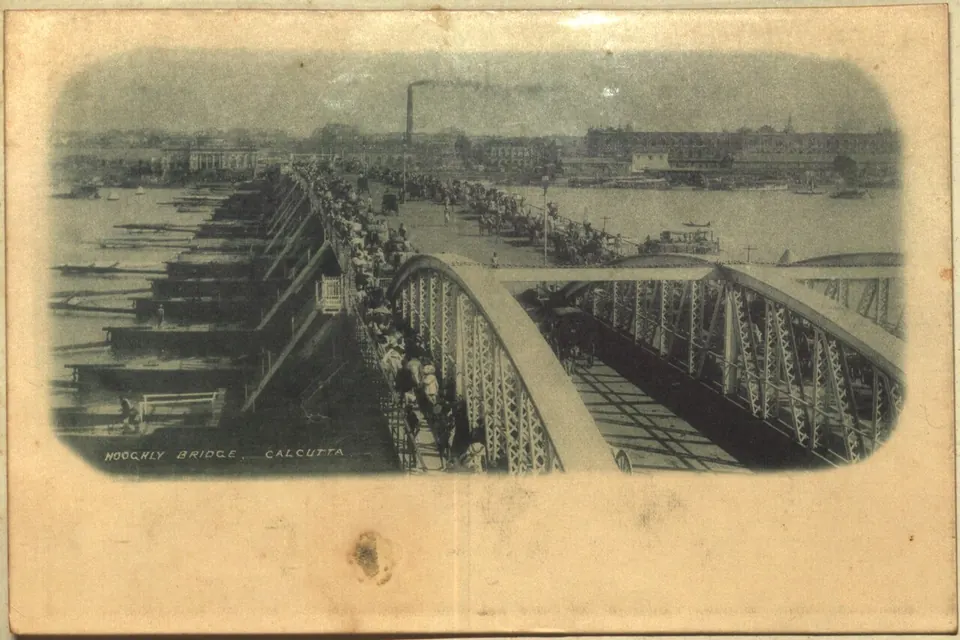
He was born on 1 September 1896 in Calcutta and educated at the Scottish Church College; his family background and childhood are covered in a separate article. He married, raised a family and worked in the pharmaceutical trade, notably in Allahabad. In 1922 he met Bhaktisiddhanta Sarasvati, who, by Bhaktivedanta's own later account, urged him to preach Chaitanya's teaching in English. He was initiated in 1933.
In 1944 he started an English magazine, Back to Godhead, which he wrote, edited and distributed largely by himself. In the 1950s he withdrew from family life, moved to Vrindavan and lived at the Radha-Damodara temple, where he began an English translation of the Bhagavata Purana with commentary. He took sannyasa from his godbrother Bhakti Prajnana Keshava in Mathura in 1959.
America and the founding of ISKCON
In August 1965, aged 69, he sailed from Calcutta to Boston on a cargo ship, the Jaladuta, with a few trunks of books. After months of precarious living in New York he rented a shop at 26 Second Avenue on the Lower East Side, and in July 1966 registered ISKCON as a religious society. Chanting sessions in Tompkins Square Park attracted young people from the counterculture. Within a year there were centres in San Francisco and Montreal; the movement reached London in 1968, where it attracted the interest of George Harrison (see our article), and spread across Europe, India, Africa and Latin America in the following decade.
Books and institutions
He considered translation and publishing his main work. His English versions of the Bhagavad-gita (Bhagavad-gita As It Is), the Bhagavata Purana and the Chaitanya-charitamrita, all with extensive commentary, were printed by the Bhaktivedanta Book Trust, founded in 1972, and distributed in very large numbers. He also established large temple projects in Mayapur and Vrindavan and, in 1970, a Governing Body Commission to manage the society after him.
Death and legacy
He died in Vrindavan on 14 November 1977. The years that followed saw serious crises in ISKCON over succession, authority and, later, the abuse of children in its boarding schools, which the society publicly acknowledged in the 1990s. Scholars such as E. Burke Rochford, Edwin Bryant and Kenneth Valpey have studied how the movement changed after its founder's death. His books remain at the centre of ISKCON's teaching, and a body of oral history, biographies and archival recordings documents his life.
A mission built on a Gaudiya Math model
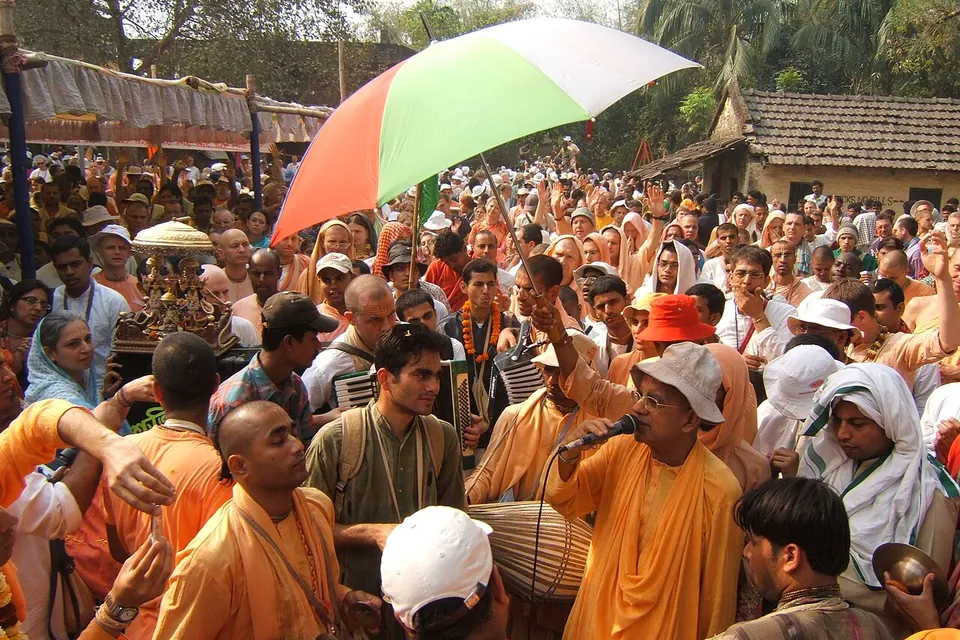
Much of what ISKCON did in its first decade had precedents in the Gaudiya Math of the 1920s and 1930s: a celibate preaching order alongside married members, the printing and distribution of books as a central activity, public chanting processions, and the use of saffron robes, shaved heads and the tilaka mark. Bhaktivedanta adapted these forms to young Americans and Europeans, adding practices suited to the new setting, such as vegetarian "Sunday feasts" open to the public and large-scale street sales of books and magazines. Historians have described this as both a continuation of his teacher's mission and a significant innovation.
Teaching and controversy
His teaching stressed four rules for initiated members, forbidding meat, intoxicants, gambling and sex outside marriage for procreation, and daily chanting of sixteen rounds of the Hare Krishna mantra on beads. He presented Krishna consciousness as a science rather than a faith, and spoke critically of materialism, impersonal philosophy and modern Western society. Some of his statements on society, gender and race, recorded in lectures and conversations, have been criticised by scholars and by later members; ISKCON institutions and academic authors have discussed how to read them in their historical context.
In the 1970s the movement faced accusations of brainwashing in the United States and elsewhere, part of the wider controversy over new religious movements. Court cases and academic studies of the period, including those collected by sociologists such as J. Stillson Judah and Larry Shinn, examined these claims.
Relations with India
Bhaktivedanta's success abroad changed his standing in India. Western devotees chanting in Indian cities attracted the attention of the press and of Hindu leaders, and ISKCON built large temples in Bombay, Vrindavan and Mayapur during his lifetime. The movement's later growth in India, where it now has a large Indian membership, is one of the striking features of its history. In 1996 the Indian government issued a postage stamp marking the centenary of his birth, and in 2021 a commemorative coin was released for the 125th anniversary, both reported by the Indian press.
His relationship with his godbrothers in other Gaudiya institutions was close but complex. He drew on their help in his early years, invited some of them to cooperate with ISKCON, and at times warned his disciples against outside influence. These ambivalent ties shaped the later relations described in our articles on Bhakti Raksaka Sridhara and Bhakti Prajnana Keshava.
Further reading on this site
The figures who shaped his formation are presented in our articles on Bhaktisiddhanta Sarasvati and Bhaktivinoda Thakura; the songs his early disciples sang are discussed in our article on Vishnujana Swami.
Sources and further reading
- Edwin F. Bryant and Maria L. Ekstrand (eds.), The Hare Krishna Movement: The Postcharismatic Fate of a Religious Transplant, Columbia University Press, 2004.
- E. Burke Rochford Jr., Hare Krishna Transformed, New York University Press, 2007.
- Satsvarupa dasa Goswami, Srila Prabhupada-lilamrta, 6 vols., Bhaktivedanta Book Trust, 1980–83 (authorised biography).
- Encyclopaedia Britannica, "A.C. Bhaktivedanta Swami Prabhupada": britannica.com.